


Argentina Glacier Law Faces Mass Legal Challenge
A legal challenge backed by over 850,000 signatures seeks to halt Argentina’s glacier law reform nationwide.
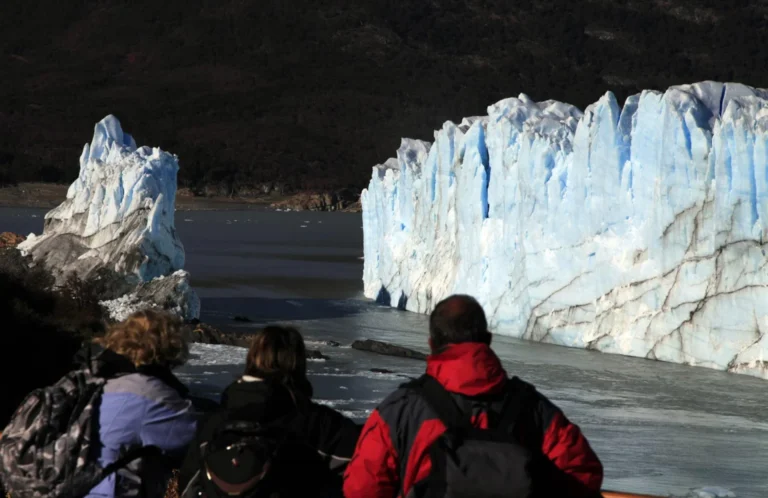
Glaciers in Argentina are central to a legal dispute over environmental protections and water resources. Photo: EFE
May 6, 2026 Hour: 2:47 am
🔗 Comparte este artículo
Over 850,000 back injunction to halt nationwide rollout of reforms weakening glacier protections
A broad coalition of environmental and civil society organizations in Argentina has filed a collective injunction seeking to suspend recent reforms to the country’s Glacier Law, with more than 850,000 individuals supporting the action.
RELATED: Argentina Approves Law Allowing Mining Near Glaciers
The legal filing was submitted before a federal court in La Pampa province following Congress’ approval of changes to Law 26.639 on April 9. Petitioners are requesting a precautionary measure to halt implementation nationwide, arguing that the reform weakens protections for glaciers and periglacial environments.
The initiative is led by organizations including the Environment and Natural Resources Foundation (Fundación Ambiente y Recursos Naturales, FARN, in Spanish), the Argentine Association of Environmental Lawyers (Asociación Argentina de Abogados/as Ambientalistas, AAdeAA, in Spanish), and Greenpeace. The signatories are calling for safeguards to protect water resources and challenging the constitutionality of the reform promoted by the government of President Javier Milei and mining sector interests.
Text Reads: We have just filed the largest collective lawsuit in history for water in the Federal Court, with more than 850,000 supporters.
The injunction demands the suspension of provisions that reduce environmental protections in glacier and surrounding ecosystems. These areas are critical to Argentina’s water system, feeding 40 percent of national basins and supplying water to more than 7 million people.
Support for the legal action extends to territorial assemblies and organizations across the country, including Jáchal Must Not Be Touched Assembly, Popular Assembly for Water, Pucará Assembly, Assembly in Defense of the Territory, Santa Cruz Assembly for Water, San Matías Gulf Multisector Coalition, Paraná Must Not Be Touched Assembly, and Alihuén Association (Asamblea Jachal No se Toca, Asamblea Popular por el Agua, Asamblea Pucará, Asamblea en Defensa del Territorio, Asamblea Santa Cruz por el Agua, Multisectorial Golfo San Matías, Asamblea El Paraná No se Toca, y Asociación Alihuén, in Spanish). Human rights and civil society groups such as Amnesty International, the Center for Legal and Social Studies (Centro de Estudios Legales y Sociales, CELS, in Spanish), and the Environmental Policy Circle (Círculo de Políticas Ambientales, in Spanish) have also joined.
Concerns have also been raised over the legislative process. According to the Asociación Argentina de Abogados/as Ambientalistas, participation in a public hearing convened by committees of the Chamber of Deputies was restricted. More than 100,000 registered participants were reportedly unable to speak, with less than 0.2 percent allowed oral interventions.
The organization stated: “the rules of the hearing were changed once registration had opened: attempts were made to validate the process by adding videos and written submissions, but with arbitrary criteria that do not meet transparency requirements.” It added: “the reform replaces a common scientific criterion with discretionary provincial decisions on what to protect and what not. This reform is not a technical update, but an attempt to fragment the protection of resources that belong to all Argentinians.”
In parallel, a federal court in Santa Cruz province has already suspended the application of the reform at the local level. Federal Judge Claudio Marcelo Vázquez granted a precautionary measure in response to an environmental injunction, halting the effects of the revised law in the province and preventing any authorization of activities in protected areas.
The broader case now seeks to extend that suspension nationwide, as courts examine the constitutionality of the reform and its implications for environmental protection and water access.
Author: MK
Source: Agencies